The components of agent memory \ Anthropic
Much of that consolidation appears to happen when our brains are offline. As we sleep, and during quiet rest, the hippocampus replays our recent experiences. This is thought to gradually distill those experiences and integrate them into the neocortex-the part of our brains that stores most of what we think of as knowledge.
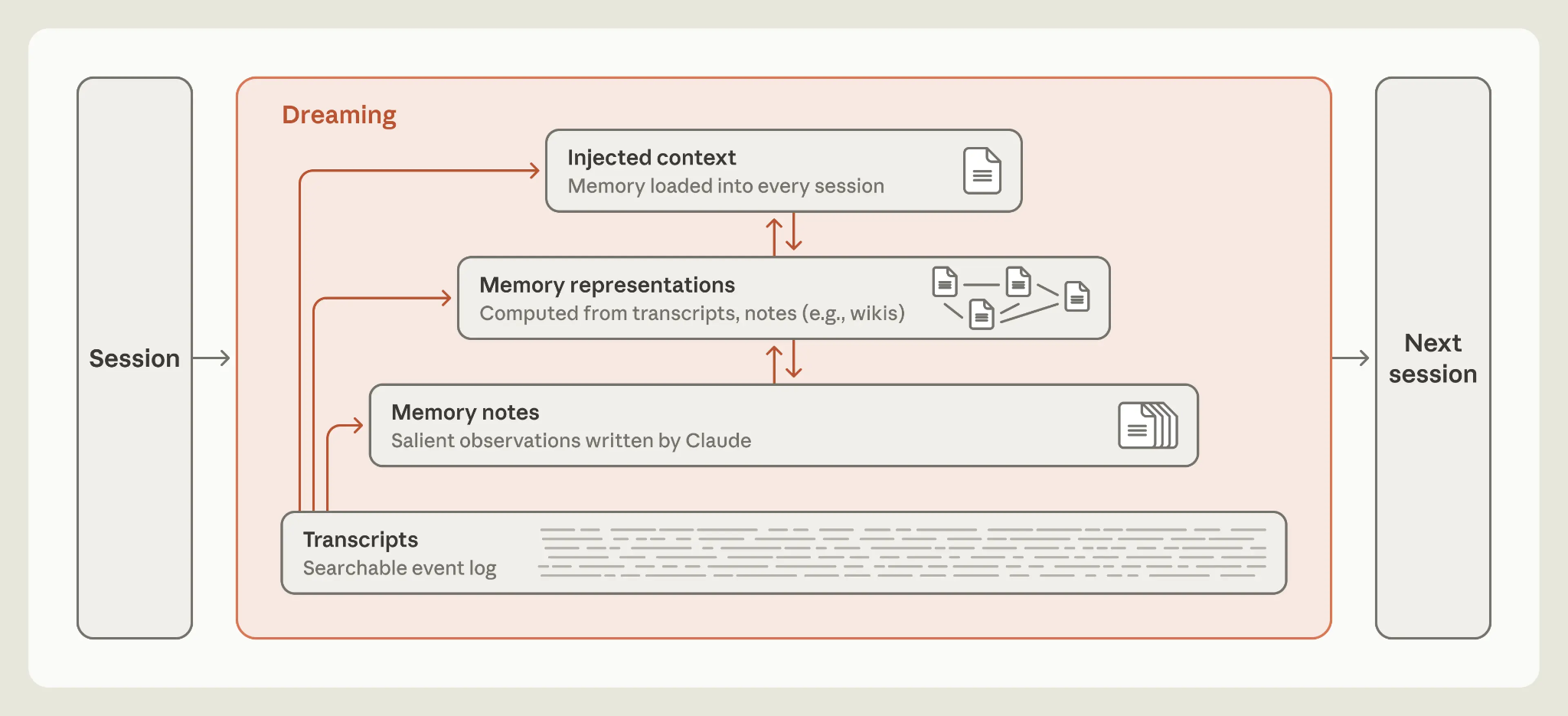
Agent memory can use a similar division of labor. Agents capture much of their work in logs or transcripts. Researchers at Letta and UC Berkeley proposed sleep-time compute as a way for models to use idle time between interactions to reorganize their existing context. The same idea can help agents organize their memory by reflecting on logs to fix mistakes or produce new notes and representations. This process is often called dreaming (Figure 1).
We've found that dreaming has been a useful tool for helping us give Claude effective memory. In this post, we share how we've come to think about agent memory and walk through several evaluations we've used to explore agent memory, including the use of dreaming, and what each component contributes to memory organization.
The components of agent memory \ Anthropic
https://www.anthropic.com/research/components-of-agent-memory