Image
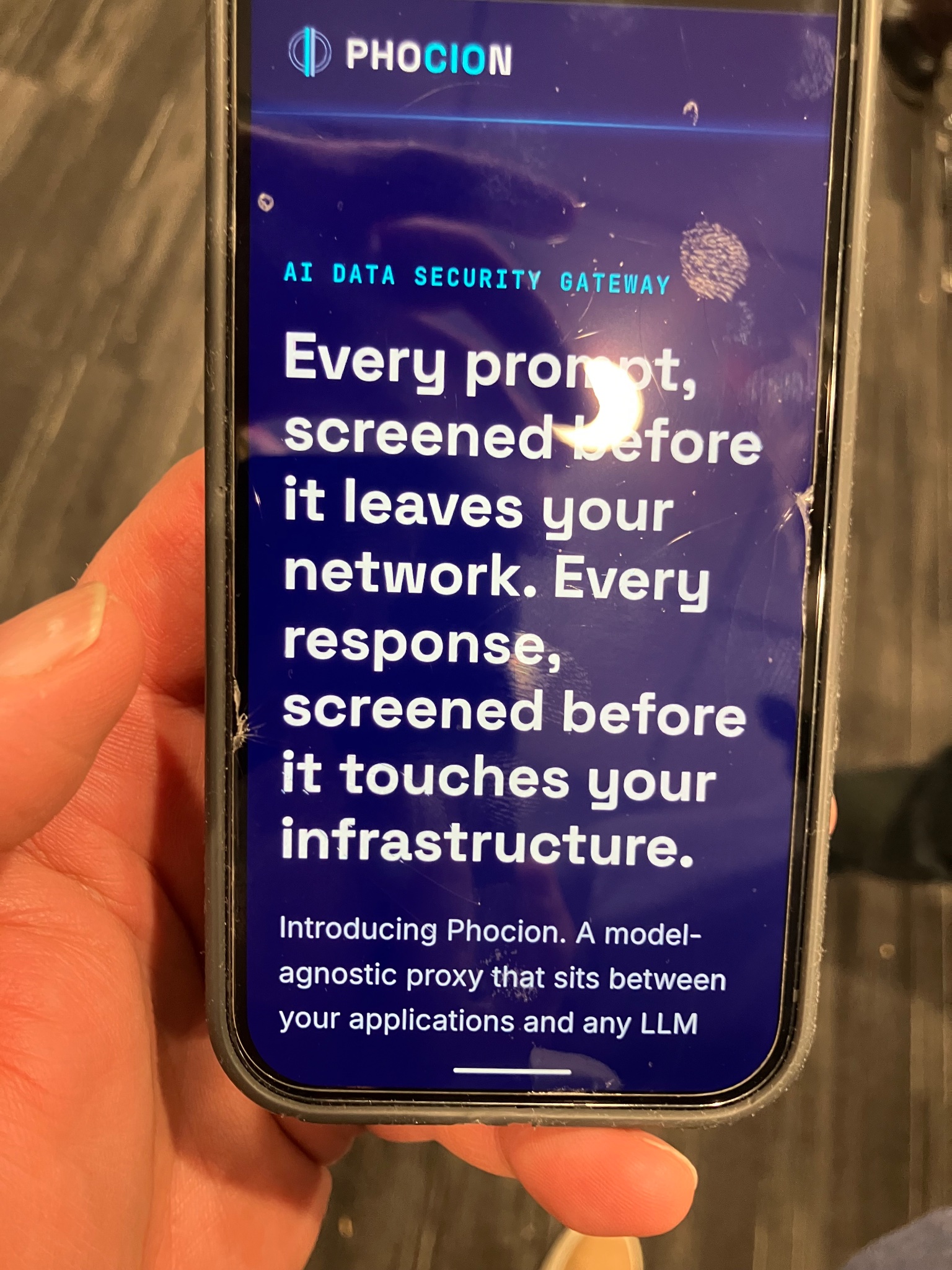
The photo is a phone showing the landing page for Phocion, which calls itself an "AI data security gateway." The pitch: a model-agnostic proxy between your applications and any LLM that screens every prompt before it leaves your network and every response before it reaches your infrastructure.
I couldn't find the company anywhere else online: no site in search results, no funding news, no docs. It looks pre-launch or very new, so what follows is about the kind of product it describes, not how Phocion actually built it.
What a gateway like this does
Companies want people and software to use LLMs, but they don't want customer records, API keys or source code pasted into a third-party model. They also don't want a model's reply, or a prompt injection hidden in a document the model read, to set off something harmful inside their systems. A gateway puts one checkpoint in the path. Apps send their model calls to the proxy instead of straight to OpenAI or Anthropic. The proxy inspects the request, redacts or blocks what policy forbids, forwards it, and checks the reply on the way back. "Model-agnostic" means the same rules apply whichever provider sits behind it.
Who else does this
Plenty of companies. Grepture, which sells one of these, splits the field into four groups: AI gateways like LiteLLM, Portkey, Helicone and Kong, built mainly for routing and cost tracking, with shallow security checks; enterprise DLP tools like Nightfall and Strac, which already scanned email and Slack and added AI APIs; guardrail libraries like LLM Guard and Lakera Guard that run inside each app; and dedicated content-aware proxies, which is where Phocion's pitch lands. Zscaler, Netskope and Cloudflare are circling the same traffic from the network-security side.
What to ask before trusting one
Where does the screening run? If the proxy is the vendor's cloud service, every prompt leaves your network to get screened, which is exactly what the headline says won't happen. A self-hosted option settles it.
What happens to streaming? Models send answers a few tokens at a time. A proxy that waits for the whole answer before checking it adds delay people notice. One writer on the topic guessed that around 200 ms of extra lag in a terminal is enough for developers to route around the tool. Scanning chunks as they arrive is harder to build.
What does "screened" mean? Regexes catch card numbers and API keys cheaply. Prompt injection and fuzzier leaks need a classifier or a second model, which costs time and money and gets things wrong in both directions.
Does it look inside tool calls? For agents, sensitive data moves through function arguments and MCP traffic, not only the chat text.
What happens when the proxy is down? Either traffic passes through unscreened, or your AI features stop.
About the name
Phocion was a 4th-century BC Athenian general and statesman, remembered for honesty and blunt speech and nicknamed "the Good." A fitting name for a gatekeeper, though Athens did end up making him drink hemlock.
Sources: